
As global air traffic continues to surge, airports are under high pressure to deliver faster, safer, and smarter passenger experiences. In response, many are seeking for a powerful new ally: AI-enabled people counters.
These advanced sensors are reshaping the way airports manage foot traffic and provides real-time insights that improve both operations and traveler satisfaction.
What is an AI people counter?
An AI people counter is a sensor that detects people and produces an entry, exit and direction reading using machine learning instead of fixed thresholds. The model sits on the device itself or on a nearby gateway, takes signals from a stereo camera, a Time-of-Flight (ToF) sensor or a fused pair, and decides which silhouettes are people, which are strollers, and which are noise. It never sends raw pixels off the device and never tries to identify the people it counts.
For the full picture of how AI people counters work and how to compare systems across sensing methods, see the AI people counting guide.
Where the AI runs: on-sensor vs gateway vs cloud
The single biggest design choice in an AI people counter is where the model executes. Three options exist in 2026, and they have very different privacy, latency and operational profiles.
On-sensor (edge AI)
The model runs on a small accelerator inside the counter, usually a low-power NPU or DSP. The raw camera frame never leaves the device. Only an anonymised count, a direction flag and a timestamp are sent to the gateway or the platform. Latency is sub-100 ms because nothing has to traverse the LAN, and the privacy posture is the strongest of the three because the camera frame is destroyed in place. The trade-off is model size: an on-sensor model has to fit the device memory budget, so accuracy ceilings are tied to the size of the silhouette-detection network the device can run.
On-gateway
The sensor sends short anonymised feature vectors (not video) to a nearby gateway, often a small fanless industrial PC that aggregates four to sixteen sensors. The gateway runs a slightly larger model that resolves edge cases the sensor could not, then forwards counts to the cloud. This pattern is common in older deployments that retrofitted ML on top of geometric sensors. It still keeps PII off the WAN, but it adds a LAN hop and a single point of failure per cluster of sensors.
In-cloud
The sensor streams video or rich feature data to a vendor backend, which runs the model and returns counts. Cloud inference offers the largest model class and the easiest model update path, but it puts a continuous video stream of every doorway onto the network, raises a clear DSGVO and EU AI Act surface, and pushes round-trip latency to the order of seconds. Hybrid fusion people counting takes the opposite approach: the heavy work happens at the edge, the cloud sees only the aggregate.
Ariadne's on-device pipeline runs the model on the sensor; no identifying data is captured, and the cloud receives only aggregate counts.
The 4 things AI actually does in a 2026 people counter
It is easy to write "AI-powered" on a datasheet. It is harder to say which decisions the model makes. Four jobs justify the AI label inside a modern people counter, and each one solves a specific failure mode that pre-ML counters had.
1. Group resolution
A family of four walking through the door close together looks like one wide silhouette to a threshold counter. A small CNN trained on top-down depth images learns to separate adjacent silhouettes by shoulder geometry and gait phase, so the count is four. This is the single biggest accuracy gain edge AI delivers in retail and airport doorways, and it is the basis for resolving group-counting failure modes AI helps solve.
2. Low-light accuracy
Geometric counters degrade in dim conditions because the depth signal gets noisier; a counter at a cinema entrance or a late-evening shop door used to lose 5-15 percent of counts after sunset. A depth-fusion classifier trained on low-light samples keeps accuracy stable in conditions where the raw depth alone would have failed, because the model can recover the silhouette from a weaker signal.
3. Stroller, wheelchair and trolley classification
A stroller is one person plus a wheeled object that looks like a second small silhouette next to the parent. A geometric counter often double-counted, undercounted, or simply got direction wrong. A small classifier trained on stroller, wheelchair and shopping-trolley shapes assigns one person to the assembly and records the wheeled object as a non-person, which is the correct accessibility-aware answer.
4. Bidirectional disambiguation
When two people walk through a doorway shoulder to shoulder in opposite directions, a fixed-line counter has to guess which crossed the line first. A motion-vector tracker that sees the last 800 ms of the scene resolves the two trajectories separately, so one entry and one exit are recorded instead of two of either. Bidirectional disambiguation is where airport-grade and retail-grade counters separate, and it is the failure mode that most often shows up as "the counter drifts at peak times."
What an AI people counter should NOT do
An honest 2026 AI people counter is defined as much by what it refuses to do as by what it does. Three jobs are explicitly out of scope for a non-biometric counter, and the vendor should be willing to put that in writing.
- Face recognition. A people counter must not attempt to identify the people it counts, store a face embedding, or match a face to any reference database. The model classifies whether a silhouette is a person; it does not classify which person.
- Demographic inference. Age estimation, gender estimation and emotion estimation are out of scope. These are biometric categorisation tasks under the EU AI Act, and they have no role in counting. Anchor traffic is anchor traffic regardless of who walked through the door.
- Individual re-identification. The system must not track an individual across two sensors or two visits. Tracking inside a single sensor's field of view is necessary to disambiguate direction; persistent identity across sensors or sessions is not, and it changes the legal category of the system.
These limits are not a marketing position. They are the reason a privacy-first counter sits outside the EU AI Act's high-risk category, and they are what makes the system safe to deploy in transit hubs, education sites and healthcare lobbies. Biometric vs non-biometric counting under the EU AI Act is the cleanest frame for this distinction.
Camera-AI vs hybrid-fusion AI, side by side
Two architectures dominate the AI people counter market in 2026. A side-by-side helps the vendor question land faster than a long paragraph.
- Privacy posture. Camera-AI: raw video either leaves the sensor or is buffered for retraining. Hybrid-fusion AI: raw video never leaves the device; only counts and direction flags do.
- DSGVO posture. Camera-AI: a DPIA is usually required, signage is mandatory, and a lawful basis (often legitimate interest) has to be defended. Hybrid-fusion AI: typically falls outside personal-data scope because no personal data is generated.
- EU AI Act category. Camera-AI: depending on what the model does, can fall into limited-risk or high-risk if biometric features are extracted. Hybrid-fusion AI: stays outside the biometric-identification category by design.
- Accuracy at the door frame. Camera-AI: strong, given the model can use full image features. Hybrid-fusion AI: equivalent, because depth fusion compensates for the lower-bandwidth signal.
- Accuracy at 12 ft ceiling height. Camera-AI: depends on field-of-view trade-offs. Hybrid-fusion AI: built for ceiling mount, accuracy stable at the heights typical in malls, airports and supermarkets.
- Demographic capture. Camera-AI: technically possible, sometimes enabled. Hybrid-fusion AI: not possible by architecture.
- Edge anonymization. Camera-AI: optional, depends on vendor configuration. Hybrid-fusion AI: not applicable, no identifying data is captured at the sensor.
The side-by-side is not an argument that camera AI cannot be done responsibly. It is an argument that defaults matter. A hybrid-fusion counter cannot accidentally capture a face; a camera-AI counter is one configuration change away from doing so.
EU AI Act category for non-biometric AI counting
The EU AI Act, in force from August 2024 with phased application through 2026 and 2027, classifies AI systems by risk. Real-time remote biometric identification is in the prohibited or high-risk band depending on context. A non-biometric people counter is not in either band, because it does not perform biometric identification or biometric categorisation.
The practical effect for a buyer in a shopping centre, an airport, a station or a public-sector venue is that a non-biometric AI counter does not trigger the heaviest compliance lift of the Act. There is no obligation around a biometric-identification system, no fundamental-rights impact assessment for that purpose, no conformity assessment for a high-risk AI system. The counter still has to comply with the DSGVO around any non-personal data handling and around legitimate-interest balancing on first principles, but the AI-Act-specific obligations are limited. Lock this distinction in writing with the vendor before signing.
How to vendor-test the AI claim: four questions to lock in writing
Most AI people counter datasheets read the same. The differences show up when a procurement team asks four direct questions and the vendor has to answer in writing.
- Where does the model run? On the sensor, on a gateway in the venue, or in your cloud? If it runs in the cloud, what data crosses the WAN, in what format, and how often?
- What does the model output? An anonymised count and a direction flag, or richer features (face embeddings, body keypoints, demographics)? Lock the output schema in the contract.
- What is the EU AI Act category your system falls into, and which article supports that position? If the answer is anything other than non-biometric / outside the biometric-identification category, the contract needs different terms.
- How is the model updated, and who approves the new version? Edge models that update silently are a procurement risk; the buyer should see a version diff and a measured accuracy delta before any rollout.
These four questions filter a category review of people-counting systems faster than any RFP scoring matrix. A vendor that answers cleanly in writing is a vendor that has already lived through one of these reviews. A vendor that hedges is a vendor that has not.
Named 2026 pilots: where AI people counters are deployed
Three short examples illustrate where AI people counters earn their place in 2026 operations. The airport case studies later in this post (Schiphol, Heathrow, Changi) sit alongside these examples; together they show the same architecture serving retail floors and transit hubs.
- Glasgow Airport uses hybrid fusion people counting at security and immigration to feed real-time wait-time dashboards. The model runs on the sensor, the cloud sees aggregate counts only, and the operations team responds to queue length without any video leaving the device.
- Munich (Flughafen München) instruments terminal flow with the same edge-AI architecture, with counters in landside, airside and retail concourse zones. The counters resolve groups walking through gates together, which is the failure mode that most often distorts dwell-time analysis at peak.
- Deichmann uses AI people counters at store entrances across European markets. Group resolution is the headline gain: family-of-four entries that used to count as one or two are now counted as four, which directly changes the conversion-rate baseline against which store-level performance is judged.
Each pilot uses non-biometric AI, no PII capture at the sensor, and aggregate-only cloud telemetry. The deployment patterns differ; the architectural defaults do not.
Inside an AI people counter: what the device actually contains
AI-enabled people counters are advanced systems that utilize a combination of signal detection and machine learning algorithms to monitor and analyze human movement. Unlike traditional methods that rely on infrared sensors or cameras, these systems detect ambient signals emitted by personal devices, such as smartphones, to anonymously track foot traffic in real time. This approach allows for accurate counting and movement analysis even in densely populated environments, all while maintaining privacy compliance by avoiding the collection of personally identifiable information.
But these counters do more than just count heads. They can:
- Measure dwell times in specific areas
- Monitor flow direction and velocity
- Detect anomalies or unusual movement
- Provide heat maps of foot traffic
- Send alerts when thresholds are exceeded
By using AI and ambient signal detection, these systems deliver granular, high-accuracy insights into human movement without capturing visual data or compromising individual privacy.
Where AI Counters Are Used in Airports?
Airports are complex environments with a variety of high-traffic zones, each facing unique challenges around crowd control and operational efficiency. AI-powered people counting systems that rely on passive signal detection are increasingly being used across key airport areas to deliver real-time insights without visual surveillance or intrusive data collection. Here’s how they’re enhancing different parts of the passenger journey:
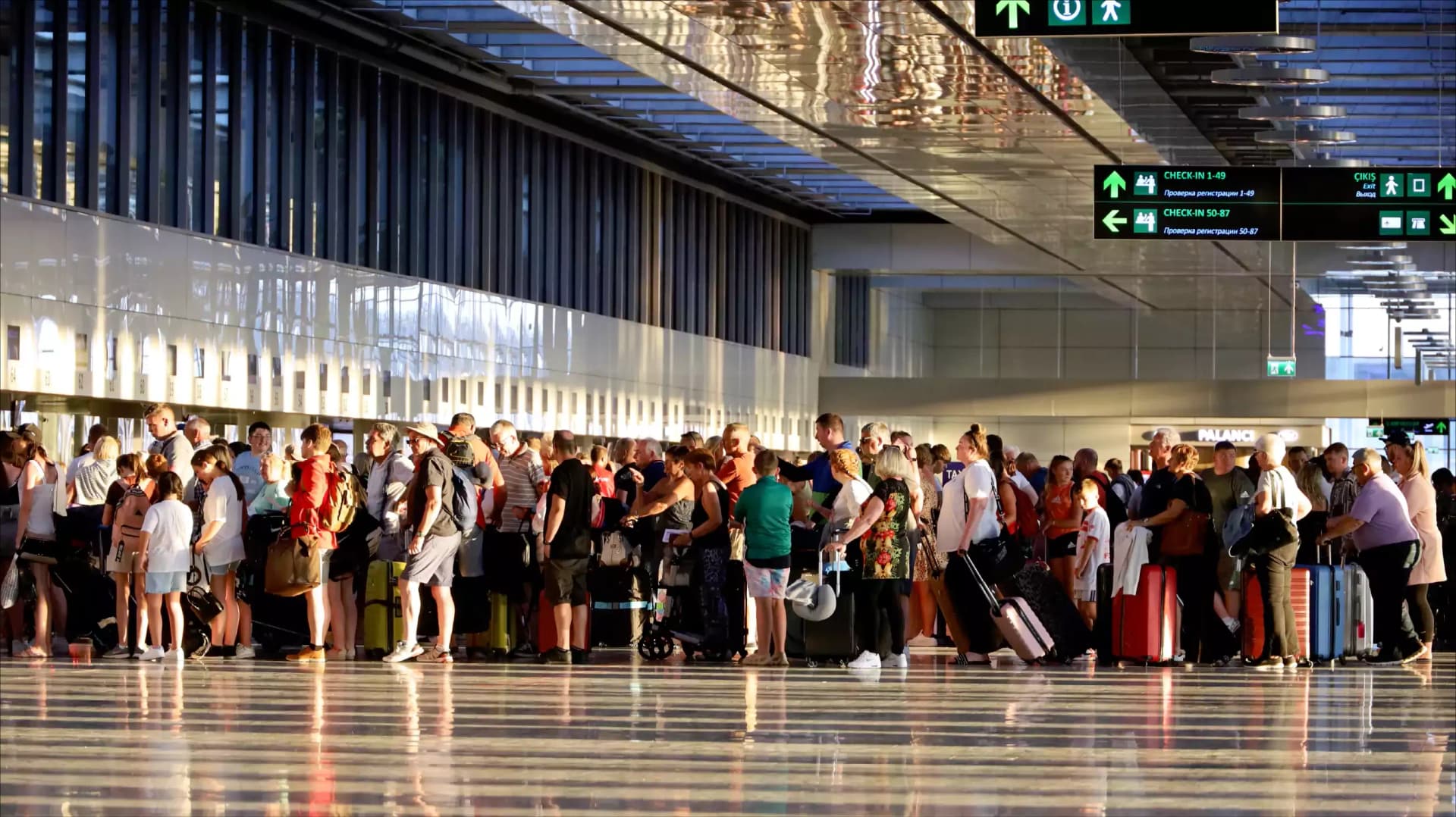
Security and Immigration Checkpoints
Long queues at security and immigration are major pain points for travelers. AI-based counters help airport staff monitor real-time passenger volumes and queue lengths, enabling proactive actions like opening additional lanes, rerouting flows, or updating digital signage with accurate wait time estimates.
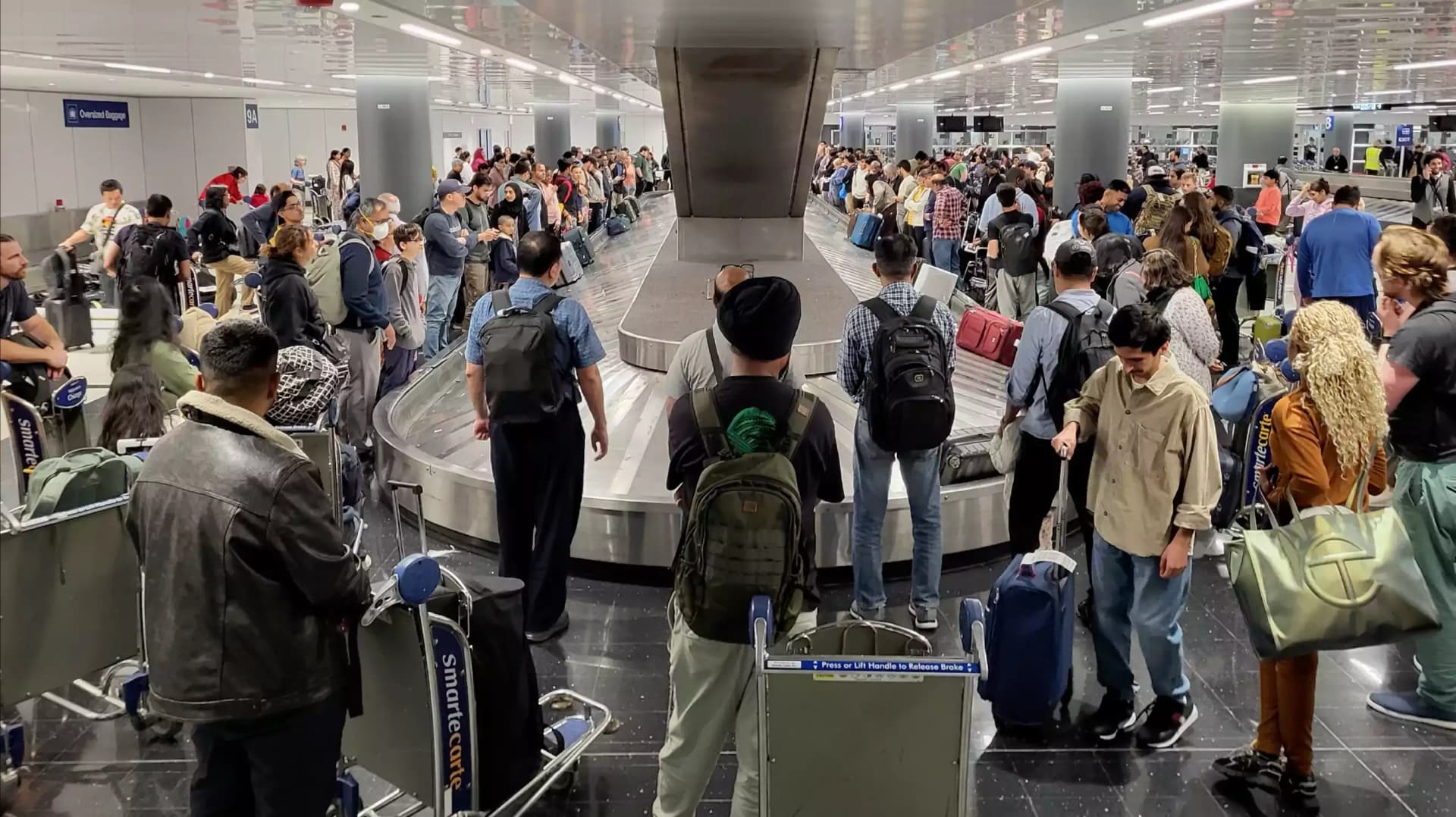
Baggage Claim and Arrivals
Crowd buildup near baggage belts and exit points can slow down movement and create discomfort. AI systems detect patterns of congestion and alert staff when foot traffic near claim zones exceeds thresholds, allowing for better crowd management and smoother circulation.
Retail and Duty-Free Zones
In commercial areas, AI people counting systems provide footfall analytics by tracking visitor flows, dwell times, and conversion patterns. This helps retail operators understand customer behavior, optimize store layouts, and adjust staffing based on peak traffic periods.
Boarding Gates
Monitoring when and how passengers arrive at gates allows for smarter boarding operations. AI counters provide real-time occupancy trends that assist gate agents in managing boarding groups efficiently and preventing last-minute surges.
Restrooms and Lounges
Cleanliness and comfort are essential for traveler satisfaction. By monitoring occupancy levels in restrooms and lounges, AI systems enable timely cleaning, restocking, and staff deployment, improving the overall passenger experience.
Benefits of AI-Driven People Counting
Modern airports are turning to AI-powered people counting systems to transform the way they manage crowds, enhance security, and improve operational performance. Unlike traditional approaches, these people counters deliver privacy-conscious insights in real time, offering both immediate and long-term value. Here’s how:
1. Real-Time Crowd Management.
One of the most significant benefits of AI-driven people counters is the ability to track passenger density in real-time. In the fast-paced airport environment, having live crowd data allows staff to respond instantly. If one terminal or checkpoint becomes congested, resources can be reallocated dynamically, and digital signage can guide travelers toward less crowded zones streamlining flow and reducing frustration.
2. Reduced Wait Times
Long queues at check-in, security, or boarding gates negatively impact passenger experience and increase the risk of missed flights. With predictive insights from people counting systems, airports can anticipate crowd surges and deploy staff or open additional service points before bottlenecks develop. This proactive crowd control dramatically reduces wait times and boosts passenger satisfaction.
3. Enhanced Security
AI-enabled people counters go beyond traffic measurement; they can also contribute to situational awareness. These systems detect unusual movement patterns, such as loitering in restricted zones or unauthorized movement in the wrong direction, and alert security personnel in real time. This enhances both regulatory compliance and passenger safety without requiring invasive surveillance methods.
4. Operational Efficiency
Staffing is one of the most resource-intensive aspects of airport operations. By relying on real-time data from people counting technologies, managers can schedule staff cleaners, agents, or attendants based on actual passenger volumes instead of assumptions. This data-driven approach to workforce allocation reduces costs while maintaining service quality.
5. Strategic Planning and Forecasting
In addition to day-to-day benefits, AI people counting solutions support long-term strategic initiatives. Historical foot traffic data can reveal trends, identify high-growth areas, and assess the impact of infrastructure changes. From optimizing terminal design to planning for seasonal spikes, these insights help airports make smarter investments and prepare for the future.
Privacy and Ethics: How is Data Handled?
In high-traffic environments like airports, it’s natural for travelers to have concerns about being monitored. However, modern AI-based people counting systems are engineered with privacy and ethical considerations at their core. These systems are designed to measure movement patterns, not monitor individuals.
Key privacy features include:
- No facial recognition or image capture
- No collection of personally identifiable information (PII)
- Signal-based detection that avoids video or biometric data
- Full compliance with GDPR and other global data protection laws
Instead of recording visual feeds, these people counters rely on passive, anonymized signals such as those emitted by smartphones or Wi-Fi-enabled devices to estimate foot traffic. The data is stripped of identifiers and aggregated for crowd-level analysis only.
Additionally, most systems use edge computing, meaning all data processing happens locally at the sensor level. This minimizes the need for data transmission, reduces exposure risk, and strengthens security and compliance protocols.
The primary goal is to empower airports with accurate, real-time insights into crowd behavior without compromising traveler privacy. Ethical design and transparency are fundamental to how people counting technologies are built and deployed today.
How Top Airports Are Transforming with AI People Counters
Several major international airports have already embraced AI-powered people counters with impressive results.
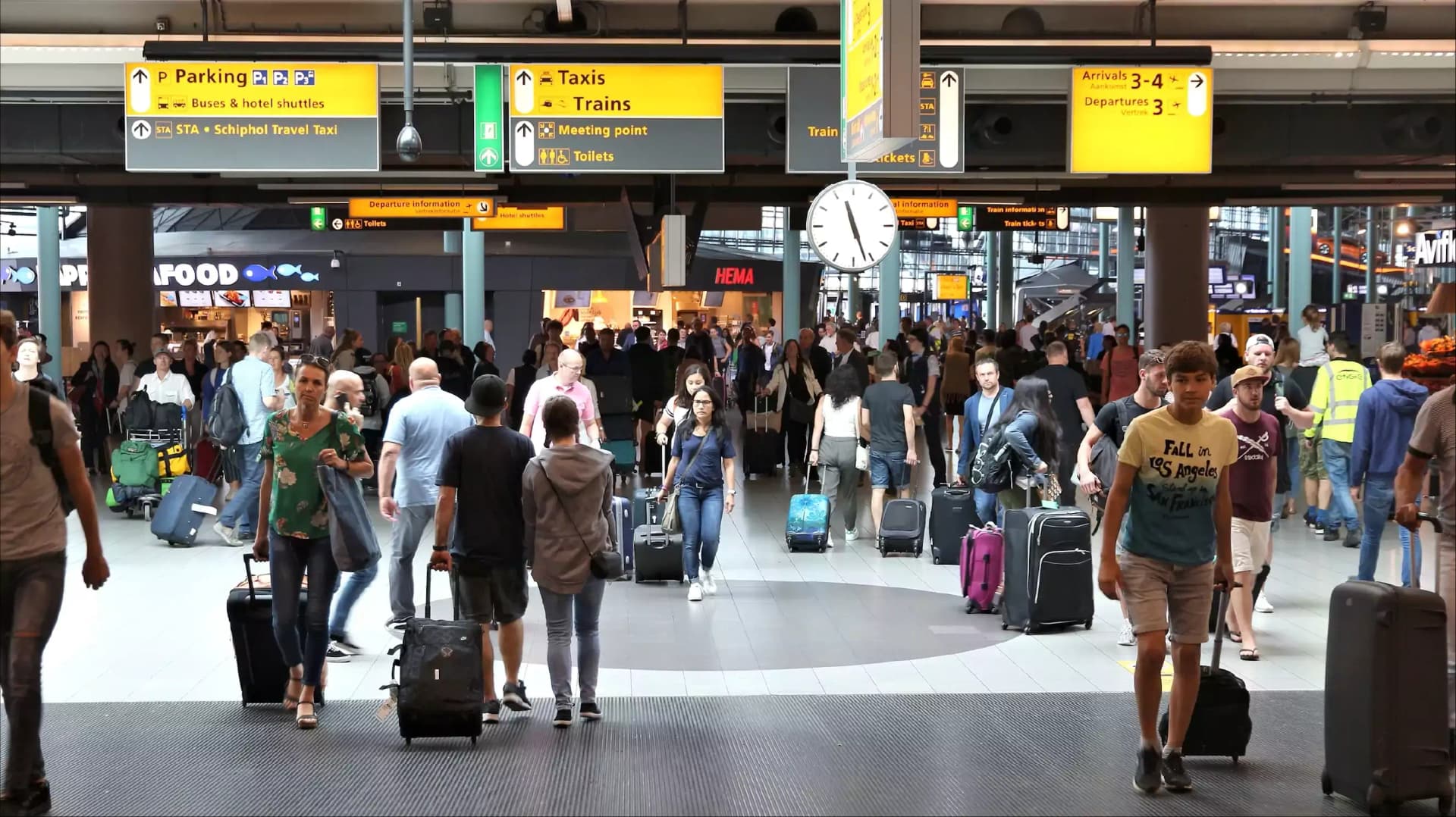
Amsterdam Schiphol Airport: Enhancing Passenger Flow with Real-Time Data
Amsterdam Schiphol Airport has integrated AI-driven systems to monitor passenger movement across various checkpoints, including security, check-in, and customs. By using real-time data, the airport provides passengers with up-to-date information on walking and waiting times through its website and app, enabling travelers to choose the fastest routes and reducing congestion.

London Heathrow Airport: Optimizing Operations Through Data Integration
London Heathrow Airport has adopted a comprehensive data platform to unify and govern its AI initiatives, aiming to better predict and manage passenger flow. This integration allows for real-time decision-making, enhancing resource allocation and improving the overall passenger experience.

Changi Airport, Singapore: Innovating Retail Experiences with AI
Singapore’s Changi Airport utilizes AI to monitor foot traffic in retail areas and lounges, providing retailers with valuable insights into customer behavior. This data-driven approach enables businesses to tailor promotions, optimize store layouts, and adjust staffing levels, enhancing the shopping experience for travelers.
Looking Ahead: The Smart Airport Era
As global air travel continues to expand, airports are embracing intelligent technologies to enhance efficiency, safety, and the passenger experience. Central to this transformation are AI-driven people counting systems, which provide real-time insights into passenger flow and behavior. When integrated with other smart solutions, these systems contribute to a cohesive and responsive airport ecosystem.
Emerging Innovations in Airport Operations
- Predictive Analytics: By analyzing data such as weather patterns, flight schedules, and historical passenger trends, AI-powered systems can forecast crowd levels and potential congestion points. This foresight enables proactive resource allocation and improved operational planning.
- Personalized Passenger Services: Integration with mobile applications allows for tailored journey planning, offering passengers real-time updates, wayfinding assistance, and personalized recommendations, enhancing overall satisfaction.
- Optimized Resource Management: Cross-terminal data sharing facilitates efficient gate assignments and baggage handling, reducing delays and improving the utilization of airport infrastructure.
The Future is in Flow
AI-driven people counters are more than just a technological upgrade; they represent a fundamental shift in how airports understand and respond to human movement. By providing accurate, real-time data, these systems enable airport managers to make better decisions, alleviate traveler stress, and operate more sustainably.
As the aviation industry evolves, airports that invest in such intelligent technologies will be better positioned to meet the demands of modern travelers, ensuring an efficient and safe passenger experience from curb to gates.
The future of travel isn’t just about getting from point A to point B. It’s about the journey in between and AI is making that journey smoother, smarter, and better for everyone.


