
Navigation with a boarding time
Terminal wayfinding differs from every other venue in one property: the destination expires. A mall visitor who wanders is browsing; a passenger who wanders is missing a flight. Airport navigation is therefore time-budget management disguised as routing: the system's real job is to keep the passenger's remaining time visibly sufficient, from curb to gate, through the one chokepoint nobody can route around.
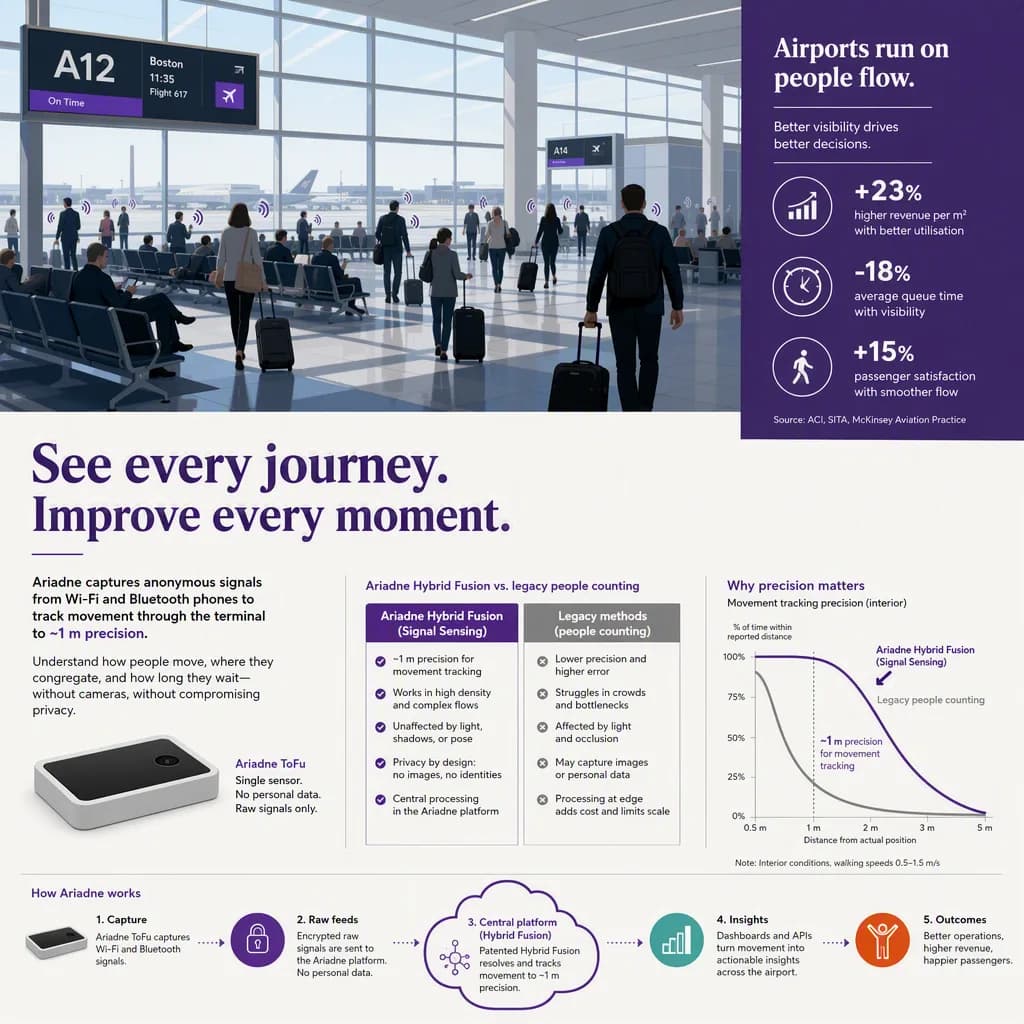
What must airport terminal navigation handle?
The full sequence: landside orientation (curb, check-in, bag drop), the security transition (where routes pause and time budgets are consumed), airside routing to the gate, and the exception cases that define the experience: gate changes mid-journey, tight connections, and the return journey through arrivals to ground transport. Delivery must work without downloads (a passenger flies through an airport twice a year; web routes from the boarding pass and screens carry the load), and multi-language support is not optional in an international terminal.
Security is the hinge
Routing to the gate is trivial geometry; routing through security honestly is the hard part, because the time cost of the queue dwarfs the walking time. Navigation that shows the route but hides the queue is lying by omission. The operational data to do better exists: measured queue states feed both the passenger's time budget and the operator's staffing decisions, the machinery covered in airport queue prediction. Post-security, the same honesty applies in reverse: a passenger with forty minutes of measured slack is a concession customer, the dynamic quantified in concession revenue per passenger.
Gate changes and connections: the exception is the product
A terminal navigation system proves itself the moment a gate changes: the route must update in the passenger's hand, with the new time budget, before the announcement finishes echoing. Connections are the same problem with higher stakes and an unfamiliar terminal. These flows are where airport navigation stops being a map feature and becomes an operations tool, and they are why the map's update pipeline (gates, closures, construction detours) matters more than its visual polish.
The Glasgow pattern
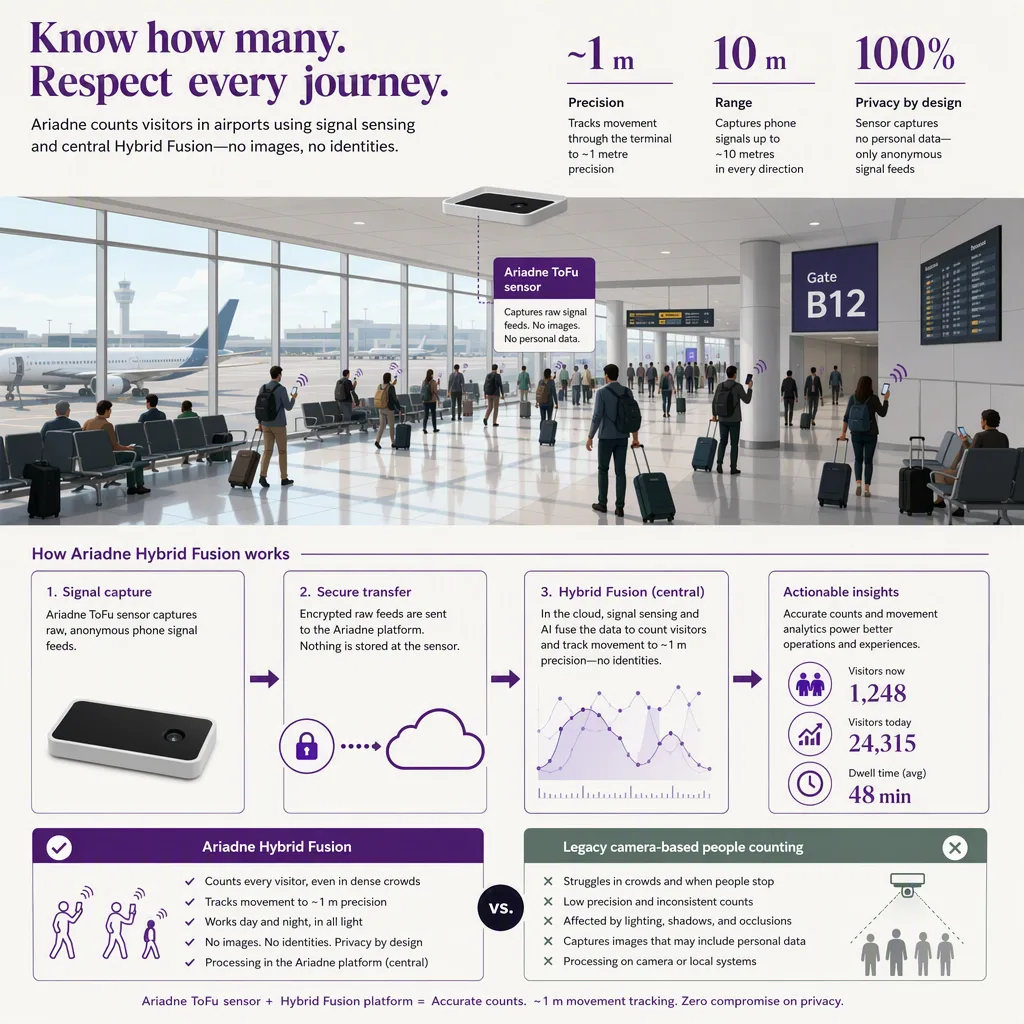
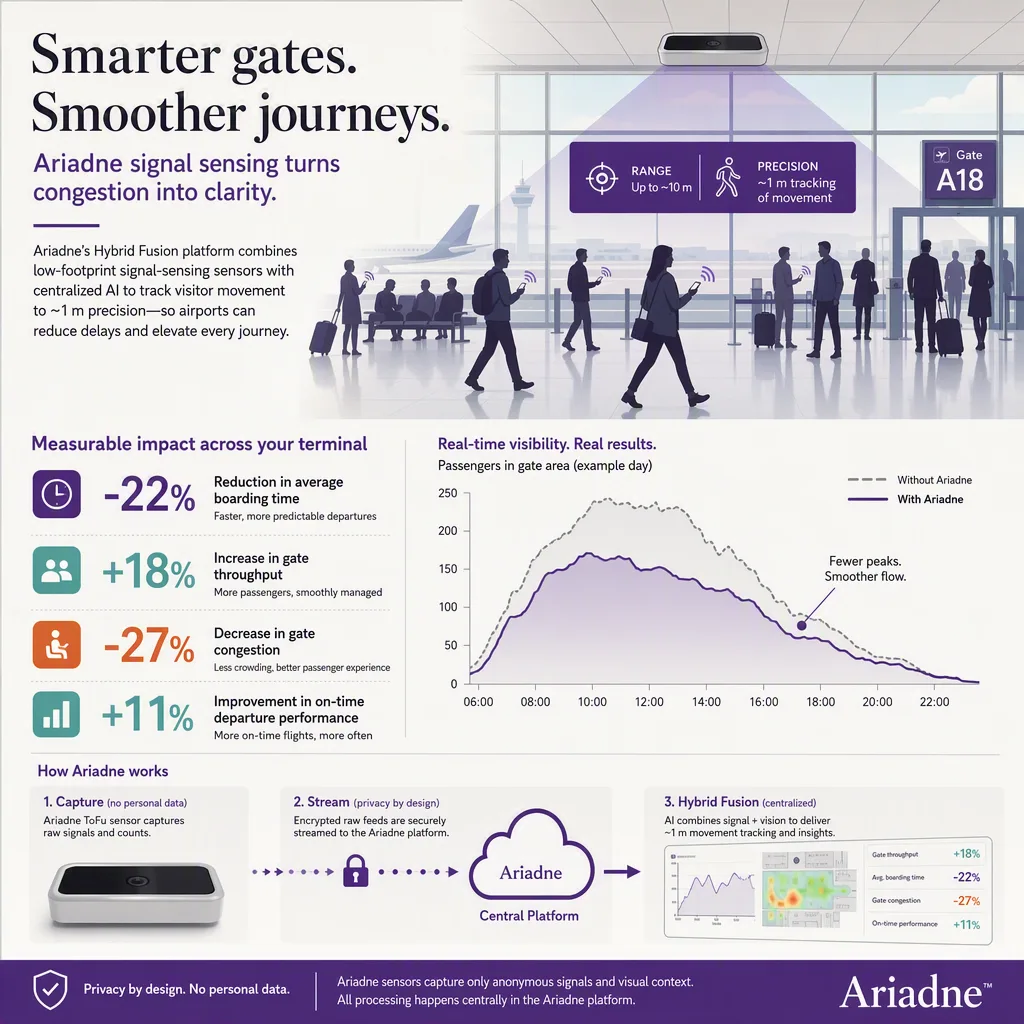
Glasgow Airport's deployment of Ariadne's wayfinding platform follows the shape this post argues for: turn-by-turn guidance through security, gate-area dwell heatmaps for the operations team, and a clean handoff to the airline's boarding flow at the gate threshold. The passenger side and the operations side run on the same measurement layer, which is the pattern worth copying: navigation that only serves passengers leaves half its value unclaimed. The measurement half is covered across airport people counting technology and the passenger flow work.
Buyer notes
Web-first delivery from boarding passes and confirmation emails; screens at decision points, placed by measured flow (kiosk placement); accessibility routing for reduced-mobility passengers as a first-class mode (accessible wayfinding routes); and a positioning layer that carries no passenger identity, non-negotiable in an environment this security-sensitive, per the argument in indoor positioning privacy. Platform context: the indoor navigation pillar.
---


