
The clauses that outlive the sensors
Counting contracts are negotiated on price and delivery, then lived with on data. Five years later nobody remembers the unit cost, and everybody cares about whether the counts can be exported, whether the vendor can use them, and what the sensor was allowed to capture in the first place. These are drafting decisions, and they are much cheaper to get right before signature than after.
What privacy clauses belong in a people counting contract?
Six, at minimum. A capability clause defining what the sensor may and may not capture (images, identifiers, biometric data), stated as a technical property rather than a policy. A data ownership clause putting the counts and derived analytics in the buyer's hands. A processing-location clause naming the region where data is processed and stored. A purpose-limitation clause preventing vendor reuse of your data for other customers or model training without explicit permission. A retention clause with defined periods for raw and aggregated data. And an exit clause covering export format, handover, and deletion at termination.
Capability beats commitment
The strongest privacy clause describes what the system cannot do. "The vendor will not process personal data" is a promise that survives exactly as long as the product roadmap. "The sensing method captures no images and no device identifiers" is a property of the hardware, testable at acceptance and unchanged by staff turnover on either side. Buyers should ask for the capability formulation and vendors who have it should offer it, because it is worth more to both parties. Ariadne's method is describable in exactly those terms:
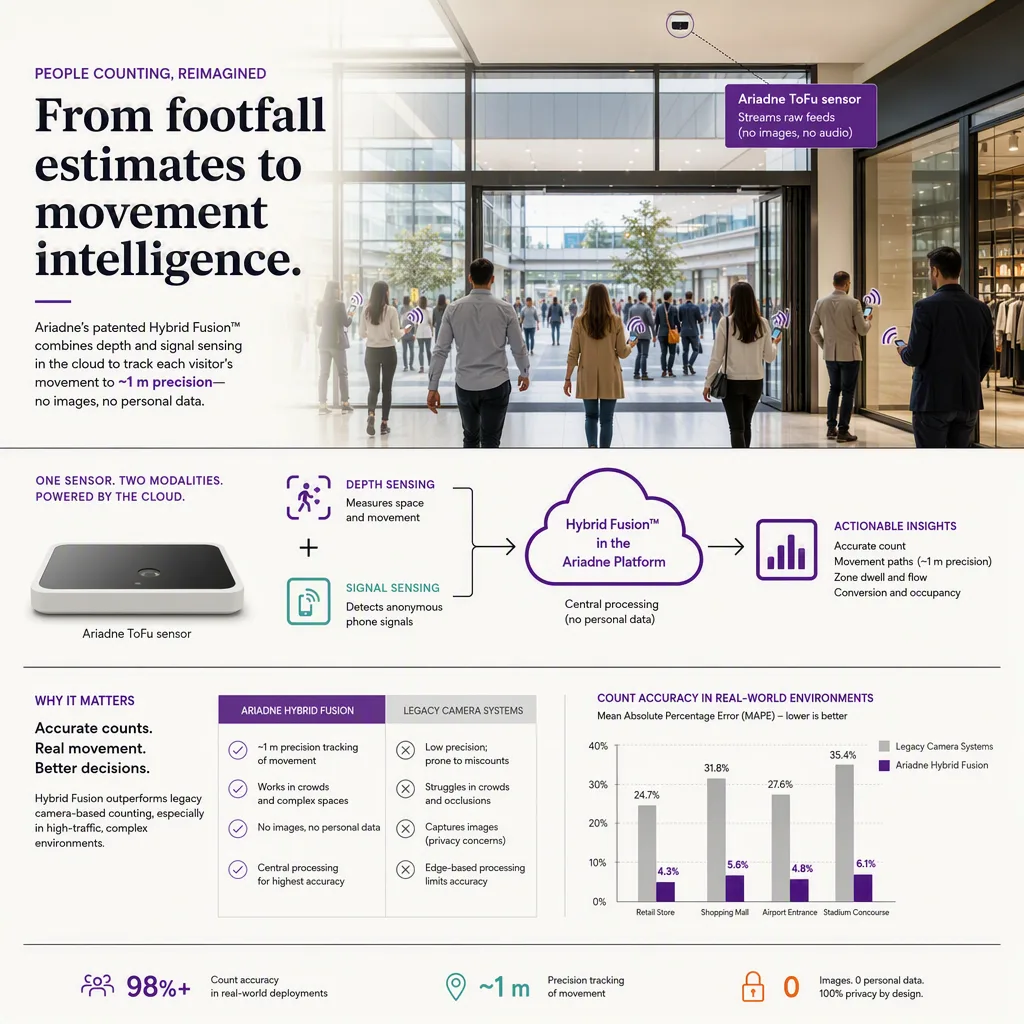
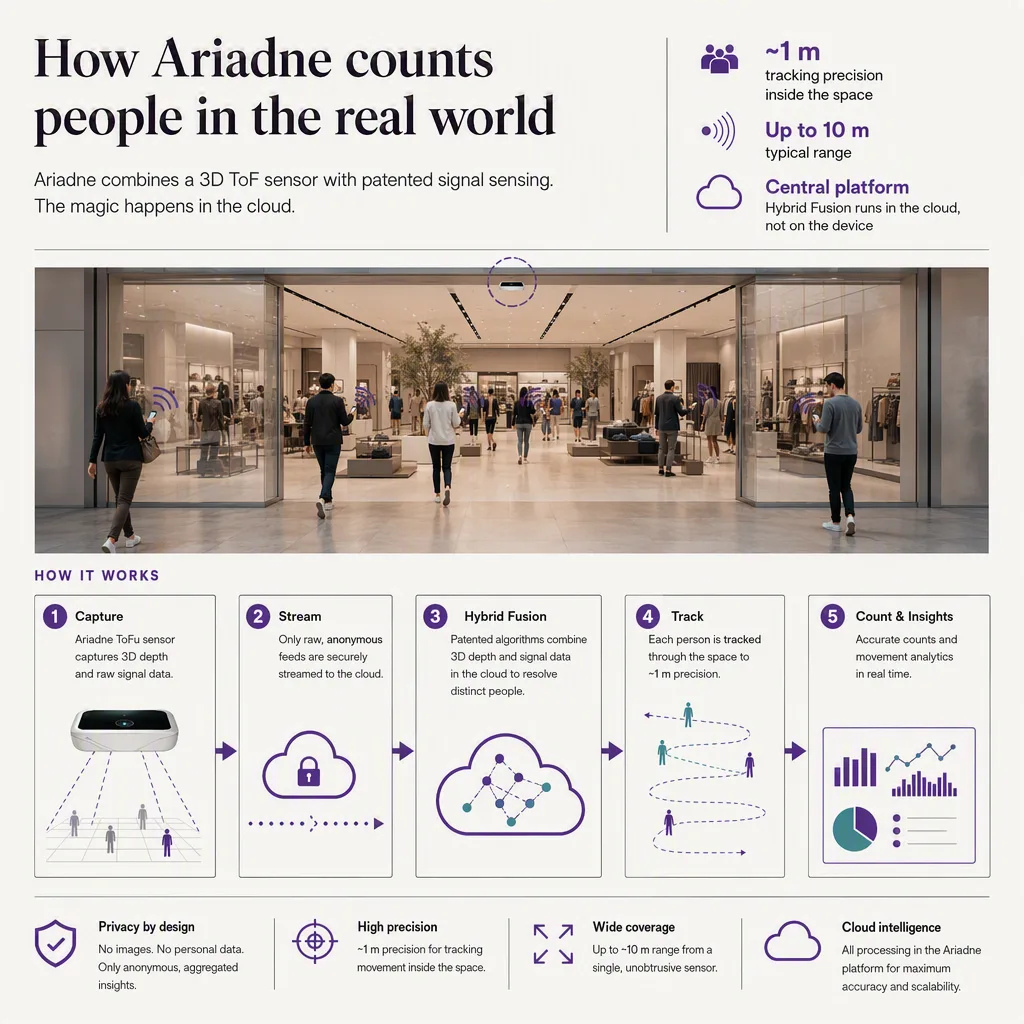
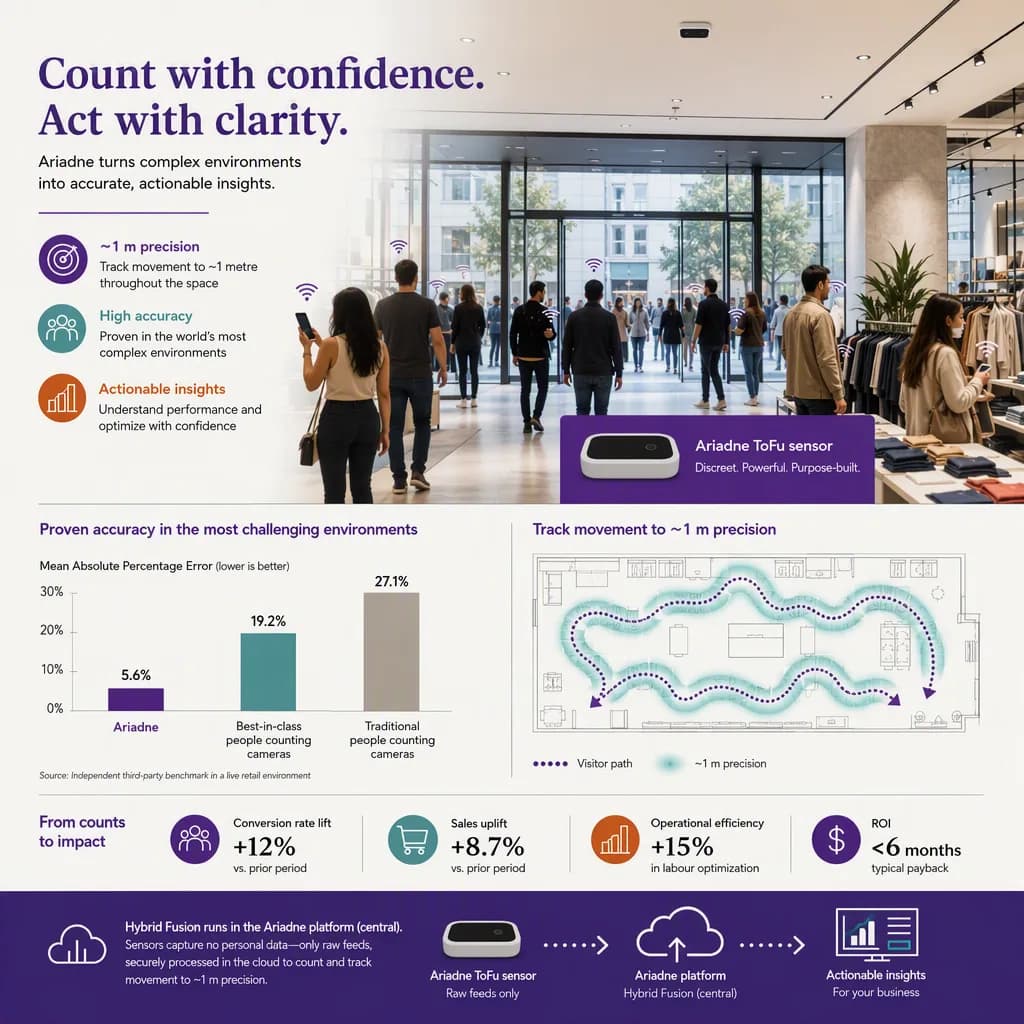
Ariadne measures this with Hybrid Fusion, its patented camera-free method. Time-of-Flight depth sensing counts every visitor at the entrances, capturing geometry rather than images, while patented phone signal sensing follows movement through the interior, detecting the signals a phone emits even in airplane mode, and tracks that movement to about one-metre precision. The sensor streams both feeds to Ariadne, where Hybrid Fusion combines them into one trajectory per visit and computes counts, dwell, and paths. The streams carry no identifier: no MAC address, no device ID, no biometric data, and no camera is involved. Identifiers are stored only when a visitor explicitly opts in, which keeps the method GDPR-friendly and outside biometric territory.
Ownership, and the reuse question nobody asks
Two clauses decide whether your counting data is an asset or a rental. Ownership: the counts, the zone analytics, and the derived metrics belong to the buyer, with export in a documented format for the whole retention period, not just the current quarter. Reuse: whether the vendor may aggregate your data into benchmarks, sell derived products, or train models on it. Both answers can legitimately be yes with the right consideration, but they should be decisions rather than defaults buried in a terms document. The integration side of extraction, whether you can actually get your data out continuously, is covered in integration requirements.
Processing location and the assessment paperwork
For European buyers, processing region is frequently a hard requirement rather than a preference, and it belongs in the contract rather than in a sales email: data residency for retail analytics covers the substance. Alongside it, agree who produces the assessment material and when. A vendor that supplies structured DPIA input (template here) removes weeks from the buyer's internal review, and the regulatory framing for counting sits in GDPR and people counting, with the US-state posture in CCPA for retail analytics and BIPA and people counting.
Workplace deployments need one more clause
Where counting touches a workplace, add an explicit no-individual-measurement clause: the system does not produce per-employee data, and reporting is aggregate above a stated minimum group size. This is the clause that turns a works-council conversation from adversarial into procedural, and it is only credible when the architecture already makes it true. The measurement pattern for workplaces is in office occupancy analytics.
The rest of the contract's question set is in the RFP template.
---


