
The journey starts three floors below the map
Most venue wayfinding begins at the entrance, which is exactly where the visitor's confusion ends on its own: past the door, there are signs, staff, and familiar retail logic. The genuinely disorienting territory is behind them: a parking structure where every level looks identical, exits are unmarked by destination, and the walk to the venue involves lifts, skybridges, or a weather crossing. Parking-to-destination is the highest-friction leg of the visit and the least mapped.
What is parking-to-destination navigation?
Routing that treats the parking space, not the venue entrance, as the journey's start and end: from "I parked on level 3, zone C" to the shop, clinic, gate, or office the visitor actually came for, and back again at the end of the visit. The return leg is the famous one: "where is my car" is consistently the most used and most loved feature in venue navigation, because it solves a real, recurring, mildly humiliating problem with zero behavior change required.
Why the parking leg fails without help
Parking structures defeat human spatial memory by design: repeated identical geometry, no landmarks, interrupted sightlines, and a distracted arrival (the driver was hunting a space, not memorizing the route). Signage fixes little because the destination vocabulary differs: parking signs speak in levels and zones, venue signs speak in shops and departments, and nothing translates between them. Navigation closes exactly that translation gap, pairing a remembered space with a venue destination in one route.
Getting the car position without tracking cars or people
The privacy-sound implementations let the visitor capture their own position (scan a zone code at the lift lobby, snap the level marker, or one tap in a web app while still at the car) rather than tracking vehicles or phones through the structure. The principle mirrors the rest of the stack: guidance needs the visitor's chosen anchor, not their identity or movement history, the same architecture argued in indoor positioning privacy.
What the venue gains
Parking navigation is measurable demand data: which entrances the parking population actually uses, how parking flows load specific lifts and doors, and where arriving visitors stall. For malls this connects directly to the finding that parking behavior and footfall interlock; for airports it is the landside half of the terminal journey; for hospitals it is routinely the difference between on-time and late arrivals, per hospital indoor navigation.
Where Ariadne fits
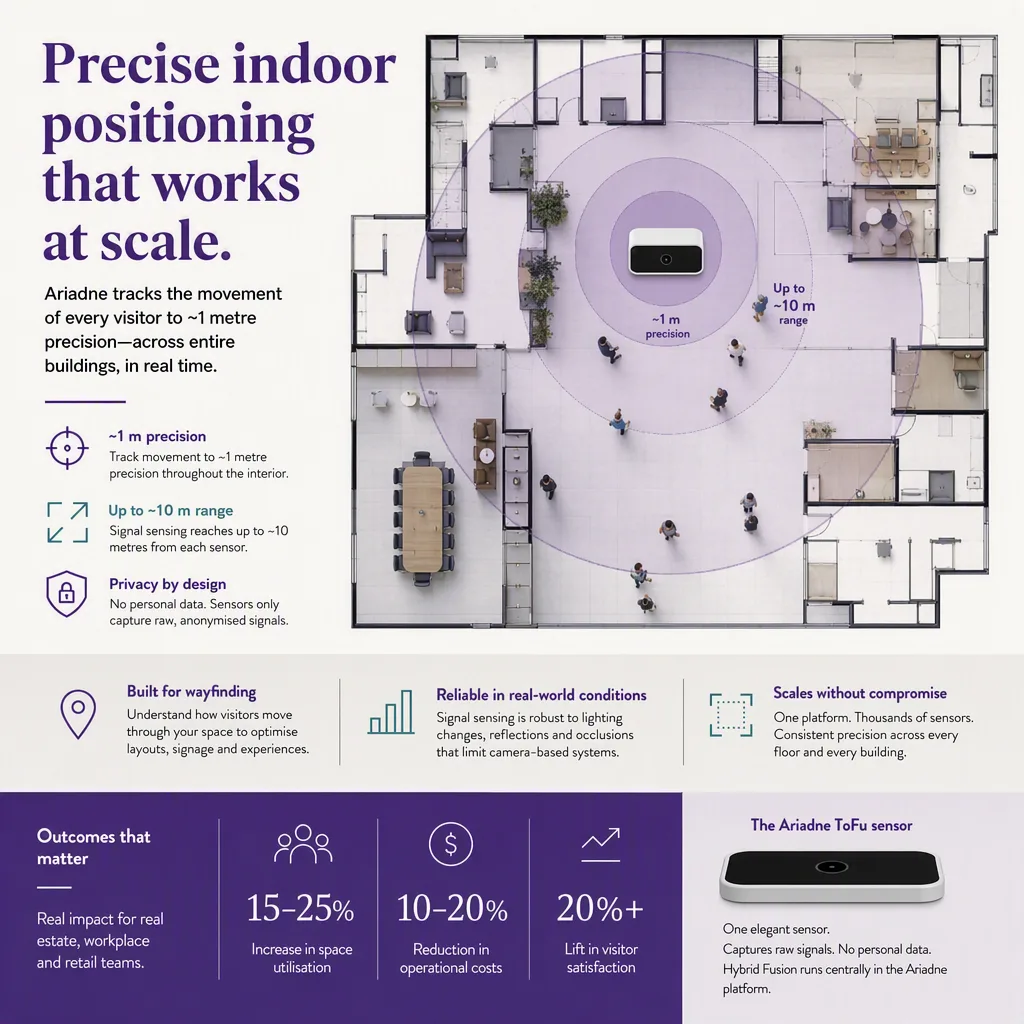
Ariadne routes from floor plans across app, web, kiosks, and signage, and the parking structure is simply part of the plan: one continuous route from space to destination and back, on positioning that carries no identity. The platform overview is in the indoor navigation pillar.
---


