
The number everyone asks for, and why nobody can honestly give it
"What is a good retail conversion rate" is the second question every retailer asks after learning to calculate conversion at all, and the honest answer is uncomfortable: the published benchmarks floating around the industry are not comparable to each other, and probably not to you. Not because the people publishing them are careless, but because the denominator is defined differently everywhere, which makes the resulting percentages different units wearing the same symbol.
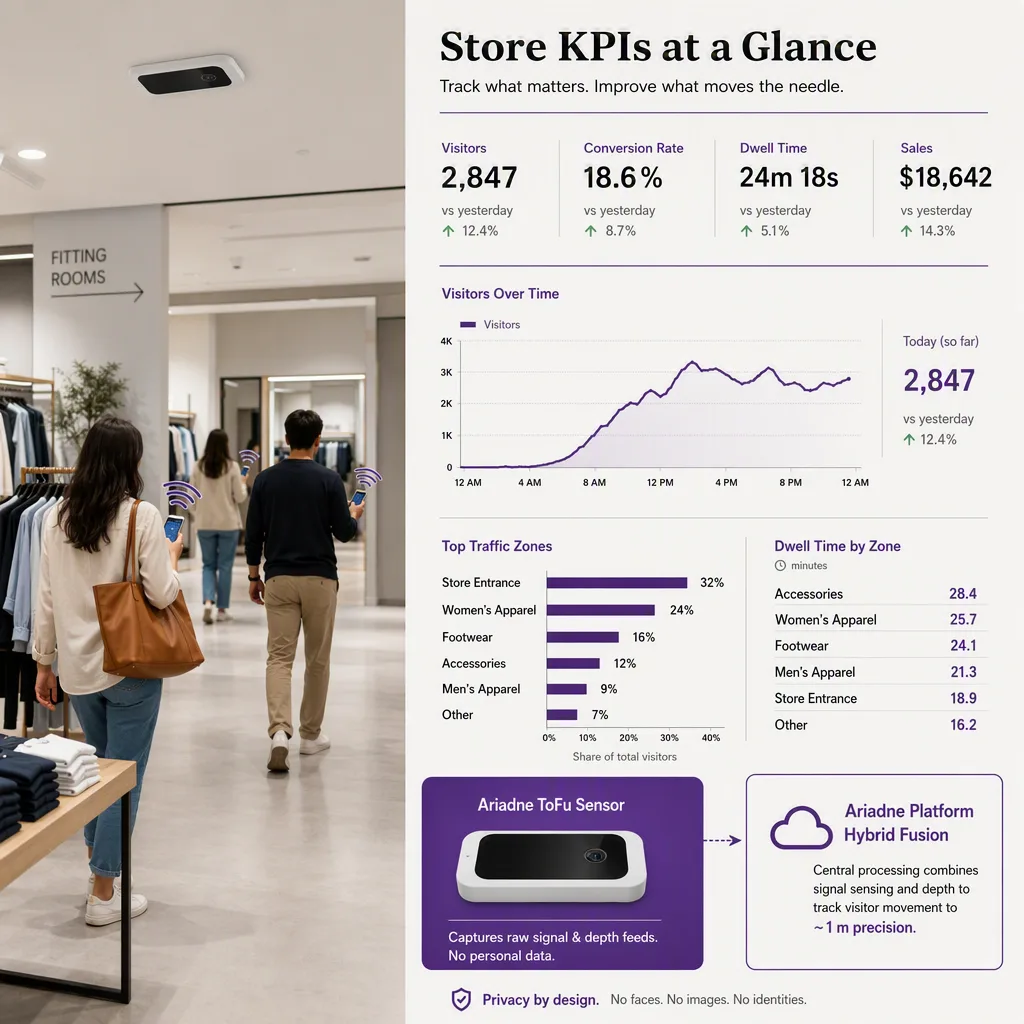
What is a good retail conversion rate?
There is no cross-industry number that is safe to manage against, because two stores can report conversion rates that differ by a factor of two while behaving identically, purely from measurement choices. What counts as a visit (every entrance crossing, or only visitors excluding staff and re-entries)? Are group arrivals counted as one visit or four? Does the transaction count include returns, click-and-collect pickups, and service visits? Change any of those and the rate moves. The only benchmark that reliably means something is your own trailing baseline for the same store, measured the same way, segmented by daypart and day of week.
Why published benchmarks are not comparable
Three incompatibilities do most of the damage. First, staff movements: a retailer who does not exclude staff crossings inflates the denominator and reports a lower conversion rate than an identical retailer who does; the mechanics are in staff exclusion. Second, counting technology: a beam counter that merges side-by-side arrivals undercounts visits and flatters conversion, while a depth sensor that resolves them reports the truth and looks worse; see group entry counting and accuracy factors. Third, definition of the numerator: including collections and returns as transactions can move the rate materially in an omnichannel business, the seam described in the omnichannel customer journey.
None of that is fixable by finding a better benchmark source. It is fixable by measuring yourself consistently.
Category matters more than any industry average
Conversion expectations differ so strongly by category that a single retail average is close to meaningless. Convenience and grocery run high, because visits are missions and the basket is close to certain, the pattern described in the grocery journey. Fashion runs lower and is decided in the fitting room (the fashion journey, try-on rate). High-consideration categories run lowest by design: furniture and electronics visits are frequently research visits in a multi-visit decision, so a low per-visit conversion rate is a feature of the category rather than a failure (the furniture showroom journey, the electronics journey). Comparing a jeweller to a supermarket produces no information at all.
Build the benchmark you can actually use
Four steps. Fix the definitions first and write them down: what a visit is, what a transaction is, how staff and groups are handled (people counting specifications has the vocabulary). Verify the counting layer so the denominator is trustworthy, per accuracy test methodology, and decide the accuracy tier the number needs, per accuracy requirements by use case. Then collect at least a full seasonal cycle, segmented by daypart and weekday, because the intra-week spread is usually wider than any benchmark gap (day-of-week footfall, conversion rate by hour). Finally, compare like with like: same store against its own history, and stores against each other only within the same format and category.
Once the baseline exists, the useful question stops being "is 25% good" and becomes "why is Tuesday afternoon eight points below Saturday in the same store", which is answerable. The calculation itself, if you need it, is in the retail conversion rate formula, and the levers are in how to increase retail conversion.
Where Ariadne fits
A benchmark is only as good as its denominator, which is why Ariadne measures visits camera-free at the door with verified counting, staff patterns handled, and groups resolved rather than merged. That gives conversion a denominator you can defend in a board pack, which is the whole point of the exercise.
---


